
British Columbia’s Historic
Declaration on the Rights of Indigenous Peoples Act
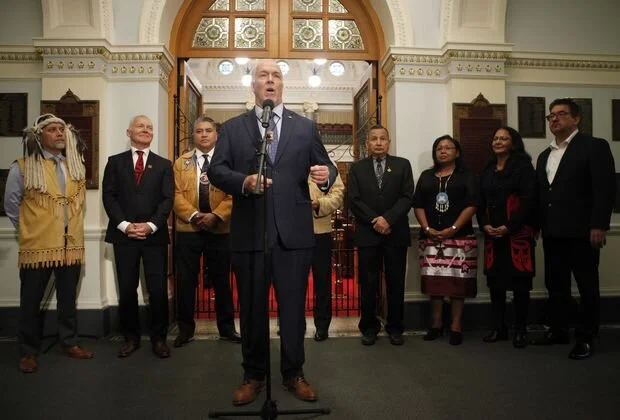
On October 24, 2019, British Columbia unveiled Bill 41, legislation intended to harmonize its laws with the United Nations Declaration on the Rights of Indigenous Peoples (UNDRIP), making it the first province to do so since Canada endorsed the UN declaration in 2016. The Bill went through committee and passed third reading on November 26 and will receive Royal Assent on November 28 at 11:30 am.
Developed in collaboration with the First Nations Leadership Council at the direction of First Nations, the Declaration on the Rights of Indigenous Peoples Act creates a framework for reconciliation in B.C., in keeping with the Calls to Action of the Truth and Reconciliation Commission.

BC is the Canada’s first province to put the UN Declaration on the Rights of Indigenous Peoples into law. The new law will recognize and protect the rights of Indigenous peoples. It will create a clear process to make sure Indigenous peoples are a part of the decisions that affect them, their communities, and their territories - and it provides a path forward for everyone.
The First Nations Leadership Council is comprised of leadership from the BC Assembly of First Nations, First Nations Summit and Union of BC Indian Chiefs.
The Truth and Reconciliation Commission called on all governments in Canada to fully adopt and implement the UN Declaration as a framework for reconciliation.
The UN Declaration is a universal human rights instrument that includes 46 articles outlining the minimum standards for the survival, dignity and well-being of Indigenous peoples throughout the world. It has the support of 148 countries.


Kate Gunn, lawyer, is an associate at First Peoples Law Corporation. Jesse Donovan is an associate at First Peoples Law Corporation.
On October 24th, the Government of British Columbia introduced Bill 41 – 2019: Declaration on the Rights of Indigenous Peoples Act. If passed, the new legislation will require the Province to embark on a process of legislative reform to ensure that provincial laws are consistent with the United Nations Declaration on the Rights of Indigenous Peoples.

November 4, 2019: The BC Declaration on the Rights of Indigenous Peoples Act is an important step by the provincial government to affirm and implement the self-determination of Indigenous peoples.
Chad Norman Day is president of the Tahltan Central Government. Kendra Johnston is the president and CEO of the Association for Mineral Exploration BC.
OCTOBER 25, 2019: Almost a century before anyone had conceived of the United Nations Declaration on the Rights of Indigenous People (UNDRIP), there was the 1910 Declaration of the Tahltan Tribe. It emphasized that those who wished to do business in Tahltan Territory would be required to work with the Tahltan Nation and show proper respect for its citizens, territory and rights. The 1910 Declaration was a progressive, inclusive path to harmonious and mutually beneficial relations between the Tahltan and industry.

Thursday, October 24, 2019, VICTORIA, BC, Lekwungen Territories – West Coast Environmental Law Association is celebrating today’s introduction of the Declaration on the Rights of Indigenous Peoples Act, which will bring the UN Declaration on the Rights of Indigenous Peoples (“UN Declaration”) into provincial law. West Coast congratulates the Government of BC and the First Nations Leadership Council who worked in partnership on the development of the Bill.

The Wilderness Committee is congratulating the government of British Columbia, as well as its partners the Union of BC Indian Chiefs, Assembly of First Nations and First Nations’ Summit, on its introduction of long-awaited legislation to implement the United Nations Declaration on the Rights of Indigenous Peoples (UNDRIP).
Public discourse about the UN Declaration and Indigenous consent typically includes the repetition of a number of myths. Often these myths are left unchallenged with many, including some political leaders and commentators, simply taking them for granted. It is timely and important to confront some of these myths.

That’s why the B.C. Federation of Labour and the Business Council of B.C. are optimistic for the long-term potential of the province’s recently introduced legislation. At its core, the legislation is about affirming human rights. But it also provides a transparent and practical process for how government’s action on implementing the United Nations Declaration on the Rights of Indigenous Peoples will unfold. In it, we see the potential for more certainty and predictability for Indigenous and non-Indigenous workers, businesses, investors and citizens, as we pursue opportunity and shared prosperity in partnership.

Nov 1 2019: It was inspiring last week to see the government of British Columbia become the first jurisdiction in Canada to move to enshrine in law the United Nations Declaration on the Rights of Indigenous Peoples (UNDRIP). This was the culmination of a process that began in 1981 with the inclusion in the Canadian Constitution of a clause recognizing and affirming the existing rights of Canada’s aboriginal peoples. Now, as we await passage of the B.C. legislation and the formal endorsement of UNDRIP by other provinces and by the federal government, we should think about why this journey has taken so long and faced so many obstacles.

October 24, 2019: British Columbia will conduct a sweeping review of provincial laws to protect human rights for Indigenous people, seeking reconciliation by providing greater influence to First Nations over lawmaking – including resource development.

October 25, 2019, Victoria, BC — B.C. MLAs have voted unanimously to give first reading to the Declaration of the Rights of First Peoples Act, a human rights bill hailed by Indigenous and non-Indigenous leaders as a major milestone on the path to reconciliation.